About This Site
What is presented here is open to interpretation, and is made in the belief that truth lies beyond words and things, however they are depicted.
The work is organized into sequences - like movies with a few frozen actors and an obscure plot. Captions and explanatory text are footnotes, not part of the story. The viewer is the director, the cast, and the audience.
Reviews of David Evans exhibitions:
First exhibit, Vanier Library, Loyola College, Montreal 1970

Galleon's Lap Gallery, Salt Spring Island - 2006

Reviews written by David Evans:


Korea - Photographs by Dave Heath
Reviewed by David Evans for Parenthesis: The Journal of the Fine Press Book Association, Autumn 2005
At first glance Korea resembles an elegant notebook or diary more than a book of war photography. Its look and feel project a mood of quiet contemplation; the pattern of its cover, textured in rich, deep earth tones, suggests hills and cultivated valleys. This is not a volume that promises to glorify military struggle or expose its carnage. The words ‘Victory’ or ‘Valour’ do not appear. There are no words at all on the front cover. Only the title and author’s name are printed in gold near the top of the spine. There are no flags, no memorials, no rows of crosses. In fact, the war is just the backdrop to the drama of the human condition- a personal account related in a sequence of powerfully moving images created by a truly visionary photographer.
The first of Dave Heath’s photographs covers a full page facing the title page. Cropped from a larger image, its scale and immediacy pull the viewer into the place and time. It is Korea in 1953 or 1954, near the end of the war. A unit of soldiers with their weapons and equipment appear to be heading into action. Some watch as others march by on foot beside a wooded hill. The two or three whose faces are visible seem grim, expectant, resigned. One holds a cigarette, a tight, nervous expression on his face. Another, standing in a jeep, folds a dark blanket as he watches the marchers. There is a sense that the cold, the mud, the discomfort, is to be cherished for a last moment- what will follow may be fearsome. Mixed with this sense of anticipation is a slight mood of bewilderment, as if no one is really sure what is going on, or why he is there. This image serves as an introduction to an emotion that forms the core of this series of images. Heath was working entirely on his own, thinking and feeling deeply about the circumstances he and other soldiers were experiencing, and discovering how photography could be used to express his concern. He was not using a camera to earn money or fame or even to document the war, he was exploring the potential of the medium to get to the root of the human condition. The body of work he created during this year in Korea became the genesis for his later work. In 1965 he published A Dialogue With Solitude, which was become a classic. It was republished in 2001 by Lumiere Press.
In Korea, Heath’s sequence of twenty-four photographs is framed by two texts: an introduction by Michael Torosian, and excerpts from interviews he conducted with the photographer. Apart from the title page detail, two additional photographs have been inserted, one into each text. The second, surprisingly, is in colour - Heath experimented with Kodachrome while he was in Korea. It provides an interesting counterpoint to the monochrome images and shows that Heath wasn’t a dogmatic purist in his use of the medium.
Torosian’s introduction, ‘A Pilgrim’s Progress’, succinctly outlines the history of the time and traces Heath’s development as an artist. Torosian lists influences as diverse as Bruegel and Minor White, but a major influence was a photographic essay by Ralph Crane in LIFE magazine. Heath had not yet turned sixteen and had been abandoned by his parents at the age of four. He was living in an orphanage. Crane’s essay was about foster children just like him and Heath’s identification with the story was so strong that it became a turning point in his life. He went to a library and began to learn about photography on his own. ‘Through a confluence of fate and intuition, in one long weekend Heath had encountered the twin precepts of personal identification and sophistication in visual structure that would be at the heart of his mature work’, writes Torosian.
In the interview section, entitled ‘A Year in Chorwon’, Heath reflects on his experiences in the army and how the photographs were made. By the time Heath was inducted into the infantry at the age of twenty-one, he had already developed a deep commitment to photography. Overshadowed by the earth-shattering events of World War II, the Korean War came to be known as ‘the Forgotten War’. Heath was a reluctant draftee but managed to assert his independence without breaking the rules. Through determination and perseverance he was able to equip himself with a camera and a good supply of film. The experience changed him fundamentally. He evolved from being an admirer of the LIFE magazine style of picture reportage into a photographer with a unique and personal ‘voice’.
The genius of Heath’s photography lies not in its ability to represent appearances, but in its capacity to evoke an intense emotional atmosphere. It is impossible to look at them and not feel empathy and compassion for his subjects. They reach out and grab you by the heart. In an opening statement, (a dedication one might say), Heath refers to these Korean photographs as being ‘…like a family album’. He was an ordinary infantryman and unlike the famous war photographers of the era (such as David Douglas Duncan), he had no press credentials and had to scrounge for a camera and film; so his photographs were made from the war’s emotional centre, not from the outside looking in. What he created are photographs of great modest and sensitivity. They are pictures of wartime camaraderie made with a sincerity that can only be expressed by one who lived those experiences. The photographs in this ‘album’ are convincing enough to make you weep. They are so beautifully composed and printed that Heath’s reverence for the great masterworks of painting glows in each face and throughout each scene. Heath describes his reaction upon seeing the first prints of what he had been shooting: ‘Basically, when I took the pictures I was photographing a homesick soldier standing in a tent door. But when I got these three by five inch drugstore prints back and I saw the close-up, I no longer saw Howard. I said to myself, “If I was a painter, this would be my study for a Christ figure.”’ This seems to have been a cathartic moment for Heath; he recognized that an intimate, personal view could have biblical dimensions. He goes on to recount that after the war, when he came across a reproduction of Leonardo’s Last Supper, he recognized a similarity with his photograph of Howard and ‘…[I] realized the picture’s iconic possibilities.’
Korea demonstrates how great photographs do not have to be enlarged to billboard proportions to be powerfully moving works of art. Torosian cites two books, Walker Evans’ American Photographs and The Inhabitants by Wright Morris as two of the most important influences on the nascent photographer. Heath made his first book (without any assistance) in 1952 and clearly he is most comfortable with this intimate format. A book that can be held easily in the hands allows the viewer to appreciate the images in relation to each other, to flip back and forth - just as one might with a family album - and to see the images in sequence. Heath understood clearly the importance of editing photographs to create an engaging narrative. With a few exceptions the images are about the same size as the drugstore prints he had made of his work while in Korea. The reproductions are a delight, printed with a rich tonality that does justice to the delicate, natural light Heath records with such graceful sensitivity. The text pages have a look and visual texture that makes reading a pleasure.
Heath’s compositions have such a natural feel that it is easy to imagine being a participant in the scene, not merely a detached observer. This makes Heath’s close relationship with his comrades is so compelling, for in spite of this apparent closeness, or perhaps because of its intensity, there is also a mysterious sense of longing that pervades these images. Although there are many close-ups, where the photographer could not have been more than a couple of feet away, I could find just two instances where the subjects look directly into the lens of the camera. Everyone is lost in his own reverie or attentive to another but not to the presence of the man behind the lens. Except for a photo of a group of soldiers who are clearly posing for the camera (not the photographer), it is as if the photographer did not exist at all. For all the obvious proximity and bonding going on, there is a profound feeling of loneliness in these images. It is this strongly compassionate identification with dislocation and separation in Heath’s photography that strikes a chord in those familiar with his work. Heath was acutely aware of human suffering, especially in the context of authoritarianism and rampant technology. One might speculate that the army, for Heath, was simply another kind of foster home, and he could identify in his comrades the alienation and anxiety with which he had become all too familiar as a child. Even though these men are not engaged in combat, mortal danger is never far away. Near the end of the sequence a man lies on his bunk with a faraway gaze in his eyes; the image on the facing page is a moonlit valley with ghost-like figures on patrol in the foreground and clouds hanging in the hills in the distance. Is that enemy territory? The final image is perhaps the spookiest. We look out from dark underbrush beside a road where troops are marching by. Brightly illuminated dust from the road suggests that vehicles have just passed. The photograph seems as if it was taken from the point of view of an enemy lurking in the dark shadows of the forest, waiting to ambush them.‘
In Korea, photography was my defining moment’, Heath says near the close of the interview. Through his passion to photograph what his heart felt, he had found a way to relate to the world and he had discovered what he needed to say. The camera gave him the means to express his inner mind, and Heath felt its potential to create a communion spirit as few photographers have. The medium of photography is deceptive. Anyone can pick up a camera and produce fine images with little or no training, but very few photographers have the instinct to give them lasting meaning. It is a simple art that is exceedingly difficult to master. Through the viewfinder, the world can look both closer and more distant. War photographers sometimes describe a feeling of being invulnerable behind the camera, yet completely involved in the moment without any separation from the action. There is an illusion of reality so convincing that it calls reality itself into question. The photographer’s perception defines the nature of what is really out there and simultaneously the photographer is defined by what he sees.
Heath uses photography the way a poet uses words. The images are simple and unpretentious, but their impact is unforgettable. Korea is quite disconcerting in this way. It is a very pleasant book to look at, to read, to touch, and to turn its pages; its contents are peaceful and yet disturbing. It is light and modest in its scope and physical dimensions but vast in its human implication because it carries the weight of a personal history. It is extremely rare to find a book of photographs as moving as Korea; we are fortunate to have this opportunity.

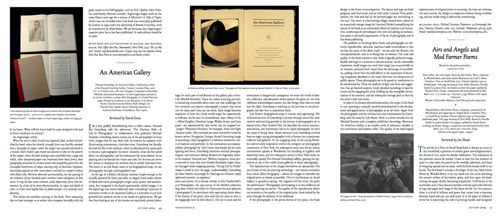
An American Gallery
Review by David Evans
Parenthesis: The Journal of the Fine Press Book Association, Autumn 2009
Like a boy giddily disembarking from a roller coaster, Howard Greenberg calls his adventure “The Glorious Ride - A Life In Photography”. In collaboration with publisher Michael Torosian, Greenberg shares twenty-six of the photographs he lives with, images that he sees daily and, for reasons he explains with illuminating commentary, cherishes most. Greenberg has literally devoted his life to the medium; when he abandoned his career path to become a photographer he knew “instantly, that all he cared about was photography” and his enthusiasm has never abated. As an aspiring artist he learned the vision and craft, but he soon put down the camera to champion the medium that so utterly fascinated him. The result is, as Lyie Rexer states in his biographical essay, we see “photography through a photographer’s eye.”
In the age of a billion cell phone cameras simple enough to be casually operated by three-year-olds, an elegant hand-made volume of black-and-white photographs might seem quaint and anachronistic, but compared to the book's passionately crafted images, it is the digital age that seems faded and stale. Greenberg's selection of innovative works in An American Gallery is a reminder of just how powerful the medium can be in the hands of a gifted artist. We get that from looking at any of the twenty-six exquisitely printed plates, (one image for each year of exhibitions at the gallery plus a frontispiece by Edward Steichen). These are subtly stunning pictures. There is something irresistible about each one that challenges the descriptive certainty one expects a photograph to assert; they never look quite the same each time you see them. Each image becomes a contemplation of how the visual world might be experienced, how the ordinary can be seen in extraordinary ways. Many of the greats - Dorothea Lange, Walker Evans, and Garry Winogrand - are represented by rare works, (an un--cropped version of Lange’s “Plantation Overseer,” for example, sheds new light on that famous work). Also included are some wonderful works by lesser-known artists: Hungarian Enrique Aznar's haunting image of a man ascending a ship's gangplank is a fabulous modernist composition of shadows and portholes. In the commentary accompanying a brilliant photograph by Ted Croner that breaks all the rules about lighting and focus, Greenberg mentions seminal photographer, designer, and instructor Alexey Brodovitch's legendary admonition to his students “Astonish me!” Without exception, these photographs astonish in ways that even Charles Baudelaire might enjoy: Consuelo Kanaga’s heart-stopping portrait, “Young Girl in Profile, 1948” makes it hard to turn the page; understandably Greenberg describes Dave Heath's stunningly lit “Hastings-on-Hudson, 1965” as “a heightened moment, an epiphany.”
Opposite each photo, (in a format similar to ]ohn Szarkowski's Looking at Photographs, the 1973 survey of the MoMA collection Greenberg often visited and where he “discovered the pure pleasure of great photographs”), he reminisces with captivating charm about some of the history of the print, how and why he came to own it and most engagingly how he feels about it. His eye is acute and his enthusiasm is dangerously contagious; we enter the world of dealers, collectors, and advocates whose passion for great art not only celebrates acknowledged masters, but also brings more obscure work into the light. Greenberg is teaching us not just how to see photo-graphs, but also how to experience them.
Lyie Rexer’s biographical essay is concise and captivating. His informed account of Greenberg's journey through one of the most creative and exciting periods in the history of photographic art is related with a New Yorker's flair. He describes the artists, mentors, associations, and movements, and as in a great photograph, we have the sense of being there. Rexer recounts how Greenberg evolved from an eager young photographer with a Pentax into a passionate collector and gallerist. It’s an engaging story of the young Brooklyn native's early inspiration within the energetic art photography community in New York, his subsequent move into the art colony environment upstate at Woodstock, his founding of a gallery and dealership there, and his subsequent return to New York where he eventually opened The Howard Greenberg Gallery, gaining the reputation as one of the world's finest galleries of classic photography.
The reproductions of the images themselves are spectacular. The use of state-of-the-art printing technology – ten-micron stochastic four-colour offset lithography - allows the images to resemble the original print as closely as possible. This is vital because, as Ansel Adams is quoted as saying, “the negative [is] the score, the print the performance.” Photographic printmaking is no less skilled an art than is painting on canvas. The quality of the reproduction draws our attention to the quality of the original print, hand crafted by the artist through the alchemy of the darkroom.
If the photography is the prima donna of this piece, the book design is the finest of accompanists. The layout and type are both gorgeous and functional, and as with other Lumiere Press publications, the look and feel of the printed pages are nourishing to the soul. The cover is a fascinating collage created from a detail of an exquisitely strange image by Frantisek Drtikol exemplifying the nature of the book as an enthusiastic blend of tradition and innovation, combining old technologies with new and adding an exclamation point to the joyful appreciation of the art of photography and of fine book publishing.
The problem in thinking about books and photographs as infinitely reproducible, identical, machine-made commodities is that we lose the sense of the object itself - we see only the illusion, the conceptualization, and in so doing lose its essence. The scale and quality of this book remind us that while a digitally perfected image, backlit and huge in a museum's cultured context, can be undeniably impressive, small images can work their magic just as powerfully on an intimate, personal level. Apart from the advantage of accessibility, pulling a book from the shelf allows us the experience of becoming completely absorbed in the work, free from the distractions of public spaces. These photographs are to be gazed at, meditations to be transformed by. There are qualities of light and form and suggestion that go beyond analysis; finely detailed recordings of specific events can be engaging but more thrilling are the intangible circumstances of the moment, and the subsequent homage paid to them by the artists craft and vision.
In spite of its modest physical dimensions, the scope of this book is vast, spanning a uniquely transformational period in the development and appreciation of photography as an art form. Apart from the photographs and the introduction and commentaries by Greenberg, and the essay by Lyie Rexer, there is a short introduction by Michael Torosian and a complete exhibition chronology. Moreover, An American Gallery is an erudite work of reference valuable to the connoisseur and amateur alike. The quality of the hand-tipped reproductions of original prints is stunning, the texts are informative and concise, the design is sumptuous without being overbearing, and the whole thing is deliciously entertaining.


Displaced
by Lauren Henkin
Reviewed by David Evans for Parenthesis
Lauren Henkin. Displaced. Portland: Vela Noche Press, 2010. 39 digitally printed photographs; text printed letterpress. Binding by John DeMerritt. Published in an edition of 60 copies. US $475.
Displaced is a beautifully realized book in which photographs—and very few words—describe the author’s changing emotional and physical states following her divorce. There are two parts to the book. The first documents Henkin’s escape from her home in Washington DC to Nova Scotia, but it is also concerned with an interior emotional space. She was immersed in feelings of loss, sadness, loneliness, and fear, and was alienated from the security of her family and even her own senses, yet the landscape and the people she discovered helped her to regain the clarity of her vision and a renewed sense of her own identity.
The sequencing of the images is effective and subtle, and helps us understand this process of renewal. At times the references are direct: in one spread, we see a mural painted on a cracked wall showing a honeymoon couple gazing from an ornate balcony; on the facing page is the interior of what might be an antique store. Dominating an array of tagged items and forgotten photographs is an empty wedding dress and a somewhat shabby tuxedo with militaristic headgear hanging over it in abject shame. A photograph of a woman with a knowing smile appears to peer out from behind the dress, her face seemingly lit by the warm glow cast by an old lampshade hanging on the wall. The message seems to be that Cupid no longer aims his arrow as reliably as he once did. This pair of images reminded me of the work of Walker Evans in American Photographs (1938). There are many other images that stand out individually while contributing to the narrative but limited space prevents me from discussing them here.
The second part of the book concerns the period following her trip to Nova Scotia. Once she returned home she experienced further shifts in her emotions and her sense of landscape. She writes about being overwhelmed by anger and her loss of control. The images here are smaller than in the first part of the book and are framed by thick black borders which appear to confine the violence within. These photographs were taken with a with a very inexpensive plastic camera and are less focused—the shaking and trembling lens conveys a desperate stumble through a blasted forest: trees and limbs are splayed, opening into a world malignant and decayed. Roots resemble animals writhing like Dante/Bosch figures—dead but suffering eternally. The final image in the book was taken while she lay on her back looking upward towards the sky with a feeling of total collapse and resignation—the sense that she may not survive another moment.
The printing of the photographs is stunning. The images glow from within the paper and although the surface is a soft and non-reflective matt, the highlights are crisp and bright, the shadows rich and deep, and the transitions smooth and natural. Printed by the artist herself using a professional Epson ink-jet printer with software adapted for black and white, the prints demonstrate that digital printing methods have advanced to the point that they can equal and even surpass traditional methods. When combined with fine bookbinding and letterpress printing, the result represents a breakthrough for photographers who in the past have been frustrated by the difficulty and expense of getting their work published in a form that has anything like the quality of an original silver-gelatin print, painstakingly crafted in the darkroom. In the hands of a skilled printer like Lauren Henkin, ink-jet printing is flexible and dynamic enough that colour can be managed exactly as the artist sees fit. And colour is an important element in a monochrome print; the precise shade of grey—warm or cool—is only obtained with great difficulty using traditional darkroom techniques. While she works with traditional cameras and film, Henkin uses digital printing technology not to create special effects, but to achieve the high standards she demands in her work.
It is rare that a book of photographs succeeds, as this one does, in conveying painful emotional states so vividly and with such beauty and grace. Displaced is also a notable and satisfying blend of letterpress and digital printing and will be an inspiration to other photographers who may consider publishing their work in this way.